What are you doing here? If you are a newly committed English major or minor, “Introduction to English Studies” will help you answer precisely this question. We will meet Tuesdays and Thursdays from 12:15 – 1:30 here in MYBK 210
Instructor
 My name is Professor Anton Vander Zee, but students tend to just call me “Prof. VZ.” You can read more about me and my background here.
My office is in 5 College Way, Room 203–straight up the outdoor stairs of the big blue house next to RITA, all the way back to the last door on your right.
My office hours this semester will be Tuesday and Thursday from 10-12, but you can also email me (vanderzeeal@cofc.edu) to set up an alternate meeting time.
Course Description
The course is designed to guide majors as they move from introductory English courses to upper-level courses in the major, and beyond. In this class, you will:
- Discuss the history of English as an academic discipline
- Read a single literary text deeply and with intention
- Explore and apply a range of useful concepts and theories for interpreting literary and cultural texts
- Practice fundamentals of analysis, research, and writing in a self-directed final project that will help you excel in navigating future English courses
- Understand the particular opportunities that pursuing and earning a major in English at CofC offers you, now and into the future
- Grasp the distinctive features of studying and writing in each of the three concentrations in the major: Creative Writing, Literature and Film, and Writing, Rhetoric & Publication.
The small class size of ENGL 299 creates opportunities for workshops, discussions, and collaboration among majors. You’ll reflect on the skills gained in your lower-level courses while discovering new ways to apply and expand these abilities and orientations.
Most of all, the small class size will facilitate a broader emphasis on conversation as a prevailing theme in this course. Our classroom space will be discussion-rich, and its success hinges on how seriously you take the work of engaging class materials and your peers with thoughtfulness and intention. We will also explore and enter a range of “critical conversations”–those dynamic engagements that both students and professional critics and scholar begin staging around their objects of study. Conversation is also crucial in other ways: I will meet with you individually a number of times across the semester; your ideas for your final project will be developed and refined through our conversations with your peers and the professor; you will be asked to compose with a series of informal “continuing the conversation” posts as a space of reflection and deepening engagement; in place of a final exam, we will have a “final conversation” in relation to your final project in the course and your experience as an early English major more generally. The word “Conversation” comes from Latin verb conversari, meaning “to live, dwell, or keep company with.” Conversation helps us dwell in ideas and dwell authentically with one another, to keep our coincidental company in this classroom close.
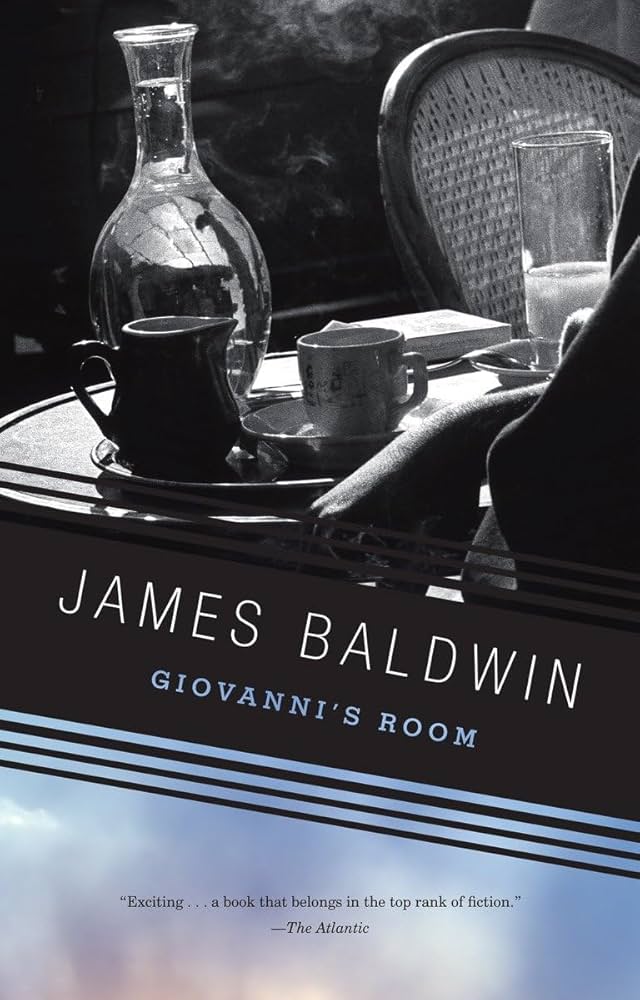
James Baldwin’s novel Giovanni’s Room (1956) will serve as our grounding literary text as we work to uncover what we might come to know about literature, and what literature might tell us about us and about our world.
By the end of this class, you will be full of ideas, curious to learn more, and confident in the hard-earned conceptual and writerly tools you have acquired. Furthermore, you will be ready to make something of those ideas and skills in each of your future classes, and, one hopes, in life more generally. That last part is especially important: superb writing skills, savvy research abilities, and the ability to critically approach the many literary and cultural texts and contexts that surround us are abilities for work and life–not just for the classroom.
Organization
The early portion of the course will unfold in a distinct set of modules. After an introductory session exploring English as a discipline, we will begin in earnest with the simple act of reading and appreciation as we read and discuss Baldwin’s novel together. Then, we will then deepen and complicate this sense of appreciation by applying a range of critical and theoretical ideas to this same novel. Maintaining our focus on this novel, we will then to turn our attention to the ongoing critical conversations that have formed around Baldwin’s novel as work to understand and engage contemporary literary criticism.
Once we reach this stage in the course, you will have already begun the early steps towards our final project, which will include a number of preparatory assignments as you select a text to engage, build a bibliography, learn how to orchestrate a research conversation, and develop an incisive and unique argument. As you work both independently and collaboratively on your final project, we will take time to understand and articulate the durable skills that you gain as an English major, learn more about the three concentrations and the education emphasis that we offer, and engage with recent alumni as they chart their professional pathways after graduation.
The course will conclude with a final, professional literature mini-conference during our final exam time, complete with special panels and refreshments.
Required Texts
There are two required texts, which available at the CofC Bookstore or online. additional readings can be found under the “Readings” tab, which is password protected.
1) An Introduction to Literature, Criticism and Theory by Andrew Bennett and Nicholas Royle, 6th edition (ISBN 978-1032158846)
2) Giovanni’s Room by James Baldwin (ISBN: 978-0345806567)

WHY ENGLISH?
In this class, students will acquire several of the competencies that make the world a better place and that are also the most sought-after skills by employers according to the NACE Job Outlook report, the World Economic Forum’s Future of Jobs Report 2025, and recent research from the National Association of Colleges and Employers. These skills include communication (written and oral), collaboration, adaptability, critical thinking, creative problem-solving, intercultural competence, and analytical thinking—all areas where English majors consistently excel and that employers across industries prioritize when hiring.
- Curiosity and a willingness to leave one’s comfort zone — essential for the lifelong learning that modern careers demand;
- The capacity to take on projects that seem particularly difficult or impractical in the context of standard operating procedure — the kind of creative thinking and flexibility that drives innovation in both startups and established organizations;
- A practiced ability to take initiative, anticipate needs, sense opportunities, and conduct meaningful analyses — skills that translate directly from literary analysis to business strategy, legal research, and policy development;
- Reluctance to unquestioningly accept appearances — the critical thinking habits that make English majors valuable in journalism, consulting, and any field requiring careful evaluation of information;
- Strong synthesis and ethical determination skills — competencies that prepare students for law, healthcare, education, and leadership roles across sectors;
- Capacity to adapt rapidly and effectively to changing circumstances — the intellectual agility that comes from engaging with diverse texts, perspectives, and historical contexts;
- Eagerness to work with people who have a wide variety of personal and professional backgrounds — intercultural competence developed through studying literature across cultures and time periods;
- Capacity to see—and take advantage of—the ways that stories shape reality (for better and worse) — understanding narrative that is invaluable in marketing, public relations, content strategy, and organizational communications;
- Disinclination to settle for the ordinary — the pursuit of excellence in expression and analysis that drives quality in any professional context; and
- Strong tendency to respect others and see the best in them, as well as a capacity to challenge people respectfully when a situation warrants it — emotional intelligence and communication skills that are essential for leadership, teamwork, and client relations;
- Ability to provide constructive feedback and engage in collaborative revision processes — editorial skills developed through peer workshops and creative writing contexts that translate directly to workplace collaboration, project management, and quality improvement across industries.
These traditional humanities competencies remain highly valued because, as economists and industry leaders recognize, every field needs skilled communicators and analytical thinkers who can synthesize complex information and present it clearly to diverse audiences.