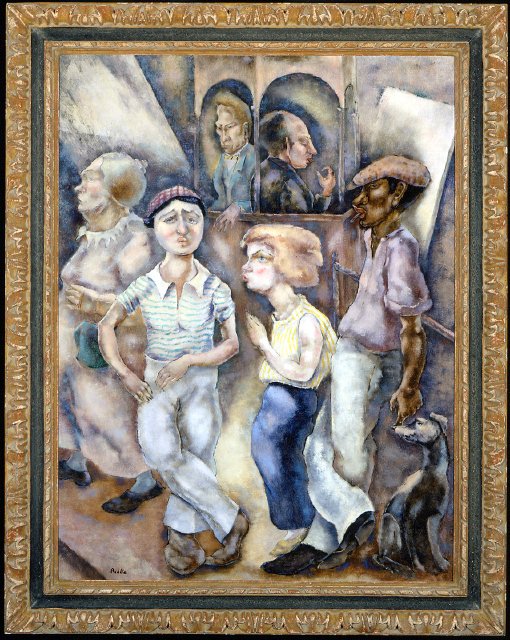
King Street Movie Painting

In 1931 when the King Street Movie painting was painted, there were a lot of issues that American painter George Biddle could see. The main problem in cities like Charleston was the segregation of people of color and white people. The black community greatly suffered injustices from segregation laws and policies that kept them out of “white” spaces. For example, movie theaters. The movies allowed for black and white audiences (they weren’t going to turn down money), but the black people had a different entrance, worse seats, and couldn’t use the same snack counters or water fountains. These were mostly the result of Jim Crow laws, which enforced what were called “separate but equal” laws for public spaces in the South. Besides this being totally unnecessary because we can all share public spaces, it also wasn’t very equal. The black spaces were almost always lower quality.

In the painting, there are five white people standing around the movie theater. In the 1930s, they were probably not as prosperous as they had once been, but they still were in a better position than the black man featured in the painting as well. The man would have to go in a different door to watch the same movie, sit in the back or in a balcony, and wouldn’t be served at the counter if he wanted pop corn or candy. He is also standing with a dog, which may be symbolic of the white people’s view of him. They would just a soon watch a movie side by side with a dog as with a black person. The painting is a snapshot of history where the injustices POC faced were part of every day life. George Biddle had lived outside of the US (in Mexico) while studying art. He would have seen a way of life that wasn’t dividing people up and telling them where they could and could not walk, drink, or exist.

King Street Movie, Charleston, South Carolina - Biddle, George

sources: Plaque at Gibbes Museum

https://www.jstor.org/journal/jsouthernhistory

1700’s miniature portraits

On the first trip to the Gibbes Museum, we looked at several miniature portraits created in the 1700-1800’s. I found learning about the history behind this artwork very interesting because it provided context to how people painted in the portraits lived their lives. There is also something to be said about how society was operated back then when observing these portraits. After viewing portraits of people from the 1700’s, I find these artworks to be some of the most historically relevant pieces at the Gibbes Museum. I think the portraits are works that make visiting the Gibbes Museum a worthwhile trip. These portraits symbolize the lives of the high class and wealthy. I viewed a large oil canvas of Isaac Mazyck II(1716-1774), one of the original nine commissioners to build St. Michael’s church.(gibbesmuseum.org, Isaac Mazyck- Gibbes Museum of Art) Mazyck is portrayed as an elite society member in this work of art. He has his hair curled and intact, is dressed in very nice clothes with a white collared shirt on and a fancy suit jacket. He is a very large and pale man, which can lead us to conclude that he is able to feed himself well and does not have to spend a lot of time outside doing manual labor in the sun. The serious look on his face and the way his head is angled makes him seem superior to those around him. The portrait painter that created this miniature, Jeremiah Theus, has only 4 known miniatures of ivory, meaning they are extremely rare and further emphasizes Mazyck’s importance.

Another miniature that stuck out to me was the portraits of Hester Tidyman Drayton (1773 & 1730) painted by Walter Robertson with watercolor on ivory. I found these portraits particularly interesting because there’s not just one, but two portraits made of the same woman. In both of these miniatures, Hester Rose Tidyman Drayton looks very elegant and almost angelic. She is dressed in a classy white dress in both portraits and has expensive looking pearl beads wrapped around her head. Like Mazyck, her skin is fair and pale, further emphasizing she does not spend her time outside doing hard labor because she can afford to stay inside because of her class standing. Back then, women were not treated or viewed as equal to men and having a portrait made of yourself meant you were very wealthy and high class. Since Hester Tidyman Drayton is a woman and has two portraits made of herself, we can conclude she was viewed as a woman of importance and had the luxury of getting her portraits made because of it. I find that these portraits are historically significant to the 1700’s south because it provides us with cultural context about how society ran. The rich and powerful wanted to be portrayed in a light that made them seem superior and wealthy, unlike the reality of many African Americans in the 1700’s south. Majority of the portraits were made for rich, white, powerful southerners and if there were portraits made of African Americans, they were painted with the children of the families that they were a servant for or owned by. I think the portraits of the African Americans that were there only further emphasize the wealthy lifestyle white southerners lived because they were able to afford to get their slaves painted as well. The portraits serve as a way for people to grasp how different life in the South was for, especially wealthy, white people and African Americans.  


Sources:

Theus, J. (n.d.). Isaac Mazyck II. Isaac Mazyck II | Gibbes Museum. Retrieved September 24, 2021, from https://www.gibbesmuseum.org/miniatures/collection/detail/0671572D-56C2-415D-864B-979135833555.

Miniature portraits. Miniature Portraits | Exhibitions | Gibbes Museum of Art. (n.d.). Retrieved September 24, 2021, from https://www.gibbesmuseum.org/exhibitions/miniature-portraits/72.


Mary Jackson Gallery – Sweetgrass Baskets

Mary Jackson Gallery at The Gibbes Museum of Art

Charleston, South Carolina is a city rich in history, one that is worthy of both celebration and sorrow. The Gibbes Museum of Art located in downtown Charleston displays this history and provides a look into southern culture through its numerous exhibits and works of art. One notable collection of art featured at the Gibbes includes the Mary Jackson Gallery of Modern and Contemporary Art, which features sweetgrass baskets created by Mary Jackson. In her basket designs, Jackson uses various materials and combines her creativity with contemporary influences and traditional basket weaving techniques. The exhibit at the Gibbes highlights three of her works, including the Cobra Basket, Never Again, and Two Lips. Jackson’s innovative designs have led her to receive numerous awards, including the reputable MacArthur Fellowship.

Mary Jackson’s “Two Lips”

Mary Jackson grew up in the South where she learned the tradition of basket making. She would spend hours with her family weaving baskets in the summertime. It was important to her parents that she learn the skill and continue the tradition of her ancestors. The concept of weaving sweetgrass baskets was brought to North America from West Africa by enslaved people. The baskets were utilized for food storage as well as in the rice fields. These baskets were particularly useful for rice cultivation because they more easily allowed slaves to separate rice from the chaff, or husk. Basket makers found the materials of the Lowcountry, such as sweetgrass and palmetto, to be similar to the materials they used in West Africa. Plantation owners recognized the value of the weavers, as not all plantations had slaves who possessed the skill needed to make them. This value allowed some enslaved families to stay together, as basket weaving was very much a family affair. The males in a family would typically gather the grasses and other natural materials while the females focused on the art and act of weaving. This tradition of basket weaving is still prominent today because of families like Mary Jackson’s who have passed down the tradition from generation to generation.

The baskets displayed at the Gibbes Museum are not only beautiful to look at, but are notable because of their celebration of Gullah and West African culture and tradition. Jackson’s work highlights a darker part of the South’s past because of the baskets’ connotation to slavery, yet her work embraces southern culture and demonstrates her pride for her heritage. In each of her intricate and unique baskets, Jackson pays homage to her ancestors and is proud to carry on the tradition of weaving. By observing Jackson’s work, one can acknowledge the baskets’ connection to the past, while gaining a greater appreciation for Gullah and West African culture. Studying the baskets allows one to make connections between Africa and the South, as well as recognize African American influence on southern culture. The skills and time needed to create the baskets are significant aspects that are also worthy of appreciation. Sweetgrass basketry is a distinguished art form that should be valued for its contribution to southern culture, as well as for the history and hard work that it represents.


Enjoying my time at the Gibbes and appreciating Mary Jackson’s beautiful work!


Sources:

https://charlestonmag.com/features/sweetgrass_basket_artist_mary_jackson

https://www.craftinamerica.org/artist/mary-jackson

https://gardenandgun.com/feature/a-lowcountry-legend-mary-jackson/

https://www.gibbesmuseum.org/programs-events/visiting-artist/mary-jackson/18


John Moultrie III and Family

The Gibbes Museum in Charleston, South Carolina, is home to many different styles of art and many different historical pieces. For my Southern Studies class, we were required to go to the museum and choose a piece to write about; I chose the John Moultrie and Family painting by John Francis Rigaud. I found it to be quite eye-catching because it really takes you back in time to how people looked back when it was painted in 1782. The painting shows John Moultrie III with his wife, Catherine Gaillard Ball, and their son, George Austin (The Gibbes Museum of Art), and it’s interesting because it shows the strong ties to England that John Moultrie and his family held.

While the painting itself is beautifully done to portray the family in the “proper” English way, the best part of the painting is its context. John Moultrie was the son of John Moultrie, M.D. and Lucretia Moultrie. He was one of five children, one of which was the famous General William Moultrie who fought for South Carolina during the American Revolution. William and John seemed to have very different views on the war effort: William was wanting to break away from England, while John was still a “Loyalist” to England. John moved to Scotland with his father and apprenticed under him, earning his medical license to be a physician before returning to the United States to formally practice. He ended up marrying Dorothy Dry Morton (who had inherited lots of money), and she was able to support the family, so he did not have to practice medicine anymore. He was then able to begin a career in politics, but Morton died shortly after. 

A few years later, he married Catherine, eloped, and had some kids (George Austin Moultrie is in the painting). He was appointed justice of the peace, and later joined the militia where he eventually ranked “major”. He later served under a British general, and after the war, moved to Florida. When Britain stopped controlling Florida, he lost his fortune and moved to England, where he spent the rest of his life.

What I love the most about this painting is how traditional and “proper” they tried to make themselves appear. They no doubtedly had status and money (or they would not have been able to afford to have such a painting done), but they really tried to make themselves appear to be the perfect family. I just find it funny that often times wealthy/noble families would get these extravagant paintings done to make themselves look a certain way, and in this case, the Moultrie family wanted to look like the perfect, “Loyalist”, English family. The painting was done with the classic, dramatic columns in the background, fruit on the table, and gold accents throughout, this art was made to showcase the family in a very rich light. The painting was also made with heavy English influence that shows the family’s strong love and ties to the Mother Country. 

This piece of art is fantastic. Without knowing the family history, the painting is beautifully done, with lots of fine details and symbolism; not to mention the classic 18th century fashion they were all wearing. Once you know the juicy family history, however, the painting seems more relatable to modern viewers. Studying this painting will help you gain a better understanding of what life was like for people during the American Revolution, especially when you take family “drama” and maintaining one’s image into the picture. It made me realize that the idea of glorifying your life portraying yourself to the public as something different than it is isn’t anything new. Reading about the history of this family and of the time period itself will help you gain a better understanding of this incredible piece. I highly recommend coming to the Gibbes Museum and studying the portraits because it truly is incredible how far some would go to make themselves “presentable” for the public eye.


Sources:

Emily Snow, The Collector, “10 Common Symbols in Still-Life Paintings & What They Mean”, 21 March 2021. 10 Common Symbols in Still-Life Paintings & What They Mean.

Geni, “John Moultrie”, 10 August 2020. John Moultrie.

South Carolina Encyclopedia, “Moultrie, John, Jr.”, 08 June 2016. Moultrie, John, Jr..

The Gibbes Museum of Art, “Object Record”, 2016. The Gibbes Museum of Art.


Photo Credits:

Photo of John Moultrie and Family taken by Colette O’Neill at the Gibbes Museum of Art on 21 September 2021.

Charleston Runner

The Gibbes museum is a great place for anybody to visit because there is a wide variety of many different types of art. While you may not be interested in what is in one gallery there is a good chance you will be interested in a piece of work in one of the many other galleries. Charleston Runner by Mary Edna Fraser may not be a piece you notice if you are looking through the museum in a hurry but if you slow down and look through all of the art you will see her Charleston Runner piece. 

Mary Edna Frasers batik piece titled Charlesten Runner to the eye may seem a bit more casual or boring than some of the other pieces at the museum, but the longer you look at the more you can understand from this piece. Mary Edna Frasers batik on silk collection has many different pieces but this was the piece on display at the Gibbes Museum. She works from an aerial perspective and these pieces often are derived from photographs she has taken from her family’s plane. Her work is inspired by where the sea, sky, and land coverage together. Each area she works on is carefully researched and looked at very carefully. She does this hiking the terrain, exploring waterways, using maps, and satellite images.

Mary Edna Fraser uses a very cool technique which is a great reason to come check out this work at the museum. Like I said earlier you would probably just look over this image, but if you knew the technique she uses you would definitely look at this image in a new way. Batik is a process in which removable wax is applied to fabric that creates areas that repel dye and the unwaxed places absorb the dye. Frasers combines chemical procion dyes, beeswax, and paraffin on silk to create her art work. This technique is traditional in Indonesia, China, Egypt, Singapore, and other places like that. This is an old technique and it is very cool the Mary Edna Fraser uses this in her work to represent different landscapes. 

From this image we can understand the technique Mary Edna Fraser uses. The colors she uses I think are very effective because they are not to bright, but they are also not to boring. You can really see the moments where the sky is touching the water and the land. This can be seen by the change in colors throughout to image. Some of her other works in the Earth collection show this better and you can tell as soon as you look at it. Charleston Runner requires a little bit more analyzing to determine these things.

Some historical and cultural concepts that can help viewers are listed above. These include knowing that this technique comes from Indonesia, Malaysia, Japan, China, Azerbaijan, India, Sri Lanka, Egypt, Nigeria, Senegal, and Singapore. We understand that this is a traditional technique used to dye textiles in these places. It is also useful to know that she captures these images using an aerial view and does extensive research on the landscape to create her images. Many of Mary Edna Frasers works are on display in the Charleston airport, this sets the tone for the beauty people are about to experience in this beautiful city.

Some resources that can help us interpret her art is to know where the initial photograph was taken and where her inspiration is coming from. I tried to research this but I did not have a lot of results. These pieces she does are all very beautiful and I think some of her other ones are a little bit easier to understand. The main thing to know to help determine the significance is to understand the technique she uses


Works Cited

“Outgoing Loans: Collaboration, Consideration, Negotiation.” Gibbes Museum of Art, 14 Nov. 2017, https://www.gibbesmuseum.org/news/outgoing-loans-collaboration-consideration-negotiation/.

“The History of Batik.” The History of Batik | The Batik Guild, https://www.batikguild.org.uk/batik/history.

“Force of Nature: CHARLESTON MAGAZINE.” CHARLESTON SC |, 18 Sept. 2018, https://charlestonmag.com/force_of_nature.

“Earth.” Mary Edna Fraser, 26 Aug. 2020, https://maryedna.com/archive/batiks/earth/.

Boone Hall Plantation

          Boone Hall Plantation is an oil painting created by Edwin Harleston in 1925. Edwin Harleston was an African American painter who was best known for his portraits. The title of the painting is misleading. The painting is titled Boone Hall Plantation (which is located in Mount Pleasant, SC), but it is actually a depiction of Oak Lawn, a plantation near Parker’s Ferry.

          The painting shows a beautiful plantation style home. When you look at the painting, it is as if you are looking through the artist’s eyes. You can see that Harleston was behind a fence, in a shaded and dark area while painting. As you look past the fence, you can see thick trees on both sides of a path. In the distance, at the end of the path, is the plantation building. It is white with a reddish color roofing. Harleston did a great job of showing the light shine on the ground and the house itself. It is ironic that Harleston made the painting lighten up in color closest to the plantation home. He portrayed a place with such a dark and racist past as beautiful. When spectators acknowledge that Edwin Harleston was an African American man, it makes them wonder if it was painful for him to paint a plantation beautifully, when it had ties to slavery.

          Right beside Boone Hall Plantation is one of the portraits he created, Portrait of Aaron Douglas. I had the chance to look at both of them and noticed something unique. Many artists make sure to sign their works in a way that stands out and can be differentiated from the painting. This was not the case for Harleston’s signatures. His signatures were done in a color similar to the background, so they were hard to find.

          While Harleston, a Charleston native, created beautiful work during the Charleston Renaissance, he is often excluded from being named as an artist of that time because of his skin color. In order to secure commissions, Edwin Harleston had to conform to attract white customers. He specialized in portraits of African Americans but would paint plantation scenes, which were popular among white artists. Edwin Harleston would have to enter plantation areas secretly because of the Jim Crow Laws. While white artists could enter wherever they wanted, African American artists did not have that freedom. 

          Someone would come to the Gibbes Museum to see Harleston’s work because many of his works have received national attention. While the Charleston art community shunned Edwin Harleston, he received numerous exhibition opportunities and commissions from across the country. It is amazing that Harleston was able to create both beautiful paintings of people and of places.

          We can gain an understanding of how African American artists had to sometimes change their artistic styles to sell paintings to white customers. Also, I learned that African Americans are often met with constant reminders of the oppression they have faced. Last year, a statue of John C. Calhhoun was taken down. African Americans were quoted in the newspaper explaining that Calhoun would no longer be standing tall and looking down on them anymore. I wonder if seeing the Calhoun statue was as hard as Harleston painting plantations in a beautiful light.

Sources

https://scafricanamerican.com/honorees/edwin-a-harleston/

https://www.gibbesmuseum.org/news/artist-spotlight-edwin-harleston-american-1882-1931/

https://thejohnsoncollection.org/edwin-harleston/


1800’s Miniature Portraits

I find these miniature portraits to be very interesting and something that people should come to this museum for. Prior to coming to this museum, I did not know what miniature portraits were. After researching and visiting the museum myself to look at the display of the many miniatures, I have come to find that these were a large sign of wealth in the 18th and 19th century among white people, especially in Charleston. I found great interest in the miniature portraits of the children in the 1800’s. I specifically viewed a miniature of a young boy named Thomas Alston (1816) which was painted by Louis Antoine Collas. This miniature was painted with watercolor on ivory. He is dressed very nicely with a white collared shirt and he sits in front of a scenic background with trees, clouds, a blue sky. I find the children’s portraits to be particularly intriguing because it shows the great amount of wealth that these white families had in the 1800’s. It is one thing to get a portrait of yourself, but to get one for your child as well means you were most definitely very wealthy. I have come to find that the first American miniatures were painted in Charleston which is very special for this city. It’s really cool to have a museum that displays art from its own city. It is a great way to represent how much things have changed since the making of these miniatures. When someone comes to visit the city, they can see what life is like now and they can compare it to the way people lived back in the 1800’s.

At this point in the history of America, there weren’t very many other wealthy people who were not white, especially in Charleston. Charleston was filled with rich white families who gained wealth from various things like rice and cotton farming. Many of them also owned plantations where they had slaves. Studying these portraits allows us to learn about Charleston’s history. Another miniature portrait that I viewed was one of General Thomas Pinckney (1818), painted by Charles Fraser. General Thomas Pinckney was a statesman, diplomat, and soldier who was born and raised in (what was then known as) Charles Town, South Carolina. He managed a plantation and then later went on to became the Governor of South Carolina. This is a prime example of white wealth in Charleston during the 1800’s. In his miniature, he was dressed nicely in his military uniform, covered with gold detailing and neatly combed hair. Not only did miniature portraits represent great wealth, but they also served as treasured remembrances of loved ones in the time before photography. It is quite interesting to see how they wanted to be portrayed by others when they got their miniature done. They wanted people to remember them and view them as wealthy, put together, and powerful. It is very lucky for us that we are able to see in person the real miniature portraits that were done, not just copies or photos. These miniature portraits represent what the people of the south, specifically in Charleston, were really like in the 19th century.


April (The Green Gown)

Childe Hassam’s work titled April (The Green Gown) from 1920 paints an unhappy woman in a bright green dress and is hung proudly on the wall of the Gibbes Museum, in Charleston, South Carolina. The inspiration behind the painting is believed to be Hassam’s mother when she was pregnant with him. The woman is seen with both of her legs and hands crossed, presenting the posture that often accompanies Southern manners. Surrounding the Woman are several birds seen in flight, which could represent freedom and a sense of being in control of one’s own life. Dr. Alice Kessler-Harris provides further context about Southern women in the 1920’s when writing, “And whatever a woman’s particular circumstances, she would find herself constrained by ideas that she was powerless to control and that profoundly influenced the legislative agenda” (Kessler-Harris 21). The birds surrounding the Woman could represent the idea of Women no longer being controlled by the main patriarch in their life, however, the thought was not yet a reality. Women were awarded the right to vote in 1920, the same year that the painting was released, which was one monumental step towards equality. 

History proves that Southern women had become accustomed to sacrificing their own needs during the time of War, and then returning to the traditional family style standards when the War came to an end. Matthew Page, author of The Women of the South in War Times, contains diary clippings of diaries from Southern Women living through the Civil War, and includes “(…) the women of the South were more than willing to suffer everything humanly possible for a cause upheld by … worthy of the confidence of their people”(Andrews 26). Women sacrificing their needs was normalized throughout the Civil War, and then against throughout World War I. This information shows that women were able to experience a sense of freedom while the men were away from home serving in the War, and when the men returned home Women’s role in society was once again uncertain. During the 1920’s when this painting was created, World War I had ended and women were in a season of waiting before the next time society needed to rely on them. The birds showcase these feelings of uncertainty and longing for freedom that Southern women at this time experienced. 

To obtain a better understanding of what Hassam’s use of the color green should represent, I looked into arguably the most well known piece of literature from the 1920’s: The Great Gatsby. The author of Great Gatsby, writes, “I saw that I was not alone-fifty feet away a figure had emerged from the shadow of my neighbor’s mansion … he stretched out his arms toward the dark water in a curious way … a single green light, minute and far away, that might have been the end of a dock,” (Fitzgerald 22). Here, the color green represents an everlasting hope by Jay Gatsby to one day reunite with the love of his life, Daisy Buchanan. The color green could represent the same idea of everlasting hope in Hassam’s painting, as the woman in the painting could have hope for her children and grandchildren to live in a better world than she has. On the contrary, the woman’s facial expression contains no joy and is very unpleasant. Perhaps, her attire represents the idea of everlasting hope, while she is personally battling to keep her head held high. While this information is not specifically from the South, the information comes from the same decade which provides useful context. 

I highly encourage those in the area to visit the Gibbes Museum and view Hassam’s work. Not only is this painting beautiful to see, it also contains symbols about the lives of Southern Women in the 20th Century, and provides insight into the fashion and beauty standards at the time. Hassam’s intentional use of color and objects provide a deeper meaning that could be interpreted differently by each individual.

Work Cited:

Andrews, Matthew. “The Women of the South in War Times.” Google Books, Google, https://www.google.com/books/edition/The_Women_of_the_South_in_War_Times/KIfBdsE5aDQC?hl=en&gbpv=1&bsq=women. 

Fitzgerald, F. Scott. The Great Gatsby. Antiquarius, 1925. 

Kessler-Harris , Alice. “In Pursuit of Equity.” Google Books, Google, 2003, https://www.google.com/books/edition/In_Pursuit_of_Equity/9Qtw5i7yQzwC?hl=en&gbpv=0.

Chapman and Walker-Charleston Harbor from Two Different Views

In the corner of the Gibbes Museum, two oil on canvas paintings shows Charleston harbor from two different views during the American Civil War. The Bombardment of Fort Sumter, Charleston Harbor, South Carolina, displays groups of people divided by social standing watching Union vessels try to take Fort Sumter as they look on from the East Battery.  The second landscape, Bombardment of Fort Moultrie, Charleston Harbor, South Carolina, displays another Union interaction from the walls of Fort Moultrie and how different the soldiers appear when compared to those at the Battery.  Conrad Wise Chapman and William Aiken Walker were both working for the Confederate States of America when they were commissioned to render drawings of Union encounters of Charleston Harbor. William Aiken Walker’s view is the most distinctly Charleston of the two landscapes where Fort Sumter and Castle Pinckney and Fort Moultrie are prominent with their confederate battle flags visible despite the smoke coming from the Union attack.  

In viewing the painting from the Battery, one can see a distinction of classes because similar people are in groups; the soldiers, the upper-class men, the middle-class women, and the enslaved are all separate.  Both paintings gave an insight into the support of the enslaved of Charleston by their positioning.  At Fort Moultrie, the slaves are almost all hidden in the bunkers while the Confederate troops man the cannons, with none of the enslaved helping to defend the fort.  At the Battery, they are the only group not watching what is happening in the harbor and talking amongst themselves.  The Bombardment of Fort Sumter also displays the immense pride of the Confederacy with the flags at the center of Forts Sumter and Moultrie as well as Castle Pinckney.  At the forefront of the landscape, the gunboat, Juno, shows pride in the Confederacy’s defense and the measures taken to protect Charleston’s Harbor from Union vessels.  You can also see the difference between soldiers in the forts and the city within the two works.  In the Bombardment of Fort Sumter, the soldiers are in nice uniforms, and the officers have their swords and adornments that specify their ranks on.  Within the Bombardment of Fort Moultrie, a more relaxed dress code is displayed, with more soldiers only wearing bits and pieces of the grey uniform of the Confederate Army.

The sketching of the Bombardment of Fort Sumter took place in 1863. Still, the work in its entirety was not completed until 1886, which may have lead William Aiken Walker to leave out or change parts of the sketch following the defeat of the Confederacy in 1865.  Standing at the East Battery today, you can see many of the landmarks in Walker’s work are still present in Charleston Harbor.  Conrad Wise Chapman completed the Bombardment of Fort Moultrie in 1864, so the likelihood of any changes made to the work after 1865 is minimal. The depiction of Fort Moultrie was not changed to reflect the fact that the Confederacy lost the war.

Easily recognizable pieces of the skyline and bright colors draw the viewer towards these two pieces located perpendicular to each other at the Gibbes as they explore two different views of Charleston during the Union attacks.  Views from Fort Moultrie and the Battery give those looking at the pieces an insight into how soldiers and enslaved acted or participated in the city compared to the Forts protecting Charleston harbor.  Bombardment of Fort Moultrie and Bombardment of Fort Sumter showcase Southern pride in Charleston and the forts that defended the city throughout the war while also giving historical accounts of these battles.  


Resources:

Bassham, Ben. Conrad Wise Chapman Artist and Soldier of the Confederacy. The Kent State University Press, 2013. 

“History: The Gibbes Museum of Art.” History | The Gibbes Museum of Art, https://www.gibbesmuseum.org/about/history/. 

“Object Record.” Bombardment of Fort Moultrie, Charleston Harbor, South Carolina – Chapman, Conrad Wise, https://gibbesmuseum.pastperfectonline.com/webobject/D6C386C9-36C0-4168-858F-561112082370. 

“Plan of the Attack on Ft. Sumter, April 6th, 1863.” The Library of Congress, https://www.loc.gov/item/gvhs01.vhs00131/. 

“Second Battle of Fort Sumter – Federals Launch Massive Bombardment and Naval Attack on Fort Sumter.” World History Project, https://worldhistoryproject.org/1863/8/17/second-battle-of-fort-sumter-federals-launch-massive-bombardment-and-naval-attack-on-fort-sumter.