ENGL 705.1, Spring 2017
Wednesday Evenings from 7:00 – 9:45
MYBK 208
 American poets have often been sustained by the power of what poet Robert Creeley would call a “company”—a group of fellow travelers in art and life who share certain core ideas about what poetry might accomplish. At times, the semantics of such assemblages are more martial or political, taking on the language of coalitions and movements, whether avant-garde or rear-guard. At times they suggest an artistic flowering, using the language of poetic renaissance. And at times, they take on the institutional language of a “school.” Whether we are talking about the Imagists or the Symbolists, the Fugitives or the Objectivists, the New Negro or the San Francisco Renaissances, the Black Arts or the Black Mountain movements, the New Formalists or the L=A=N=G=U=A=G=E poets, the New York School or the Darkroom Collective, the Confessionals or the Beats, the coalitions of CantoMundo or Cave Canem, such assemblages can help poets make sense of themselves, and they help critics organize—both aesthetically and ideologically, in the moment or in retrospect—the explosive growth of American poetry over the past century.
In this class, we will take this broader tendency to “school” our diverse American poetries as a point of departure: How did such schools come to be? What do these schools clarify? What do they obscure? Who gets included? And who remains on the outside? And how have anthologies historically functioned as a means of defining and canonizing these schools? In addition to a diverse range of poems from across the twentieth century, readings will include primary sources such as manifestos, poetics essays and glimpses into historically important anthologies. Our goal will be to become familiar with the most important movements and poets in twentieth century American poetry even as we critically explore how those poetries have been organized, packaged, and schooled.
Of course, American poetry is large and diverse, and I hope students in this course develop, across the semester, a deep curiosity about the schools and movements that we might have to overlook, or that are just emerging on the scene. To give this curiosity some room to unfold itself, the final few classes will be reserved for student-curated reading lists related to the respective final research projects.
Learning Objectives:
By the end of this class, students who successfully complete this class will have demonstrated the ability to:
- Distinguish modern and contemporary poetry from what came before (Romantic and Victorian poetry)
- Develop a thorough understanding of various poetic schools and movements across the twentieth century and beyond
- Articulate how various historical and contextual forces shaped modern poetry
- Propose, develop, and deliver a well-researched, historically-focused analytical project focused on a poetic school or movement of their own choosing
MA Program Outcomes
In addition to the above, students who successfully complete this class will have demonstrated the ability to:
- Convey sophisticated ideas in clear prose
- Analyze the complexities of language in literary and cultural texts
- Interpret the significance of texts within particular geographical, cultural, and historical contexts
- Discover and evaluate literary and cultural criticism within the context of specific assignments or projects
- Integrate literary and cultural criticism into their own writing
Required Texts:
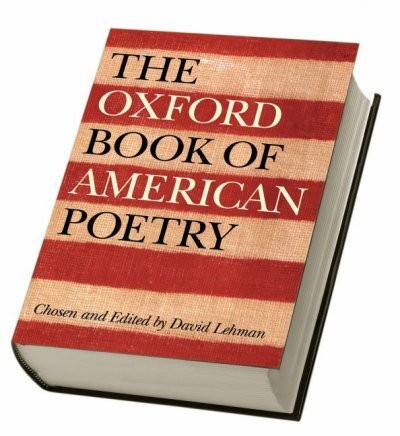
The Oxford Book of American Poetry, ed. David Lehmen (2006). Additional texts for purchase might be required, and there will be a range of readings each week accessible through the “Readings” tab. Check e-mail for password.
Note: While I anticipate that the basic course structure below will remain in place, I will be adding–and potentially changing–readings in advance of any given week. The required reading for any given week will always be provided, in final form, no less than one week prior to that meeting date. Readings for week 3, for example, will be finalized no later than our meeting time for week 2. All readings beyond the required course text can be found under the “Readings” tab on the course website.
Week 1: January 11–Course introduction, preparatory readings
Readings:
From The Oxford Book of American Poetry (2006)
- Henry Wadsworth Longfellow, “The Fire of Drift-Wood” (42-43)
- John Greenleaf Whittier, “For Righteousness’s Sake” (51-52)
- Oliver Wendell Holmes, “Contentment” (59-61)
- Walt Whitman, Song of Myself, sections 1 and 2 (84-85) & “To a Stranger” (144-145)
- Herman Melville, “Shiloh” (154)
- E.A. Robinson, “The House on a Hill (194-195) and “Richard Cory” (196)
- Stephen Crane, “In the Desert” (203-204)
- Paul Laurence Dunbar, “We Wear the Mask “ (210)
- Emily Dickinson, “I died for beauty—but was scarce (170); The Brain—is wider than the sky (175); “Pain—has an Element of Blank” (177).
Historical Poetics:
- Louis Untermeyer, American Poetry Since 1900 (1923)
Critical Readings:
- Jahan Ramazani et. al, eds, “Introduction,” The Norton Anthology of Modern and Contemporary Poetry (2003)–read the introductions to both the “modern” and “contemporary” volumes
- John Timberman Newcomb, “The Emergence of ‘The New Poetry,'” fromThe Cambridge Companion to Modern Poetry (2015), ed. Walter Kalaidjian
Week 2: January 18—Imagism, Symbolism, Vorticism and the Modernist Experiment
Readings:
From The Oxford Book of American Poetry (2006) unless otherwise noted
- Gertrude Stein: “Guillaume Apollinaire” (240); “Cezanne” (240), “If I told him: A Completed Portrait of Picasso” (242-244); from Tender Buttons, Objects” (LINK)
- Wallace Stevens: “Disillusionment of Ten O’Clock” (249); “Sunday Morning” (250-252); “Thirteen Ways of Looking at a Blackbird” (255-257); “Anecdote of a the Jar” (257-2580); “Tea at the Palaz of Hoon” (258); “The Snow Man” (258-259); “Study of Two Pears” (264-265); “Of Modern Poetry” (267); “The Motive for Metaphor” (267-268).
- Mina Loy: “Gertrude Stein” (276)
- William Carlos Williams: “The Young Housewife” (277); “Danse Russe” (278); “Portrait of a Lady” (278-279); “By the Road to the Contagious Hospital” (281); “The Rose is Obsolete” (282-283); “To Elsie” (284-285); The Red Wheelbarrow” (285-286)
- Ezra Pound: “The River-Merchants Wife: A Letter” (301-302); “In a Station at the Metro” (302); “The Lake Isle” (302-303); from “Hugh Selwyn Mauberly” (305);
- Robert Frost: “Mending Wall” (212-213)
- H.D.: “Helen” (316); “Epitaph” (316-17); “The Moon in Your Hands” (317)
- Marianne Moore: “Poetry”: (323-324); “The Fish” (324-325); “To a Steamroller” (235); “An Octopus” (333-339)
- T.S. Eliot: “The Waste Land” (351-65)
- Archibald MacLeish, “Ars Poetica” (385-386)
Poetry from the Archive
- Mina Loy, “Love Songs” (6-8 in the inaugural 1915 issue of Others)
- T.S. Eliot, “The Love Song of J. Alfred Prufrock” (in the June 1915 issue of Poetry)
- Some Imagist Poets: An Anthology “Preface” (v – viii) and all excerpts from H.D.
- Catholic Anthology 1914-15, excerpts from Pound (86-89)
Historical Poetics and Manifestos
- Mina Loy: Feminist Manifesto
- Ezra Pound: Review of Others from The Little Review (1918) (56-58); “Imagisme” and “A Few Don’ts by an Imagiste” from Poetry (March 1913); and “Vortex” from Blast 1 (153-154)
- T.S. Eliot: “Tradition and the Individual Talent” (1919)
- W.B. Yeats: “The Symbolism of Poetry,” from Ideas of Good and Evil (1902)
Contemporary Critical Readings:
- Korg, Jacob. “Imagism.” A Companion to Twentieth Century Poetry, edited by Neil Roberts, Blackwell, 2001, pp. 127-137.
- Golding, Alan. “Experimental Modernisms.” Cambridge Companion to Modern American Poetry, edited by Walter Kalaidjian, 2015, Cambridge UP, pp. 37-49
- Gelpi, Albert. “Introduction” to A Coherent Splendor, Cambridge UP, 1987, pp. 1-7.
- Peter Nichols. “The Poetics of Modernism.” Cambridge Companion to Modernist Poetry, edited by Alex Davis and Lee M. Jenkins, Cambridge UP, 2007, pp. 51-67
Assignments Due:
- Blog Post 1
Week 3: January 25—The Harlem Renaissance and the New Black Experience
Readings:
From The Oxford Book of American Poetry (2006) unless otherwise noted
- Angela Weld Grimke: All excerpts (272-273)
- Claude McKay: All excerpts (382-384) and “The Lynching“
- Jean Toomer: All excerpts (409-411) and “Portrait in Georgia“
- Sterling Brown: All excerpts (456-459) and “Southern Road,” and “Ma Rainey“
- Langston Hughes: All excerpts (468-475) and “Theme for English B,”I, Too,” and “The Negro Speaks of Rivers, and “Po Boy Blues,” “Hard Daddy“
- Countee Cullen: All excerpts (477-478)
Historical Documents & Essays
- From W.E.B DuBois, The Souls of Black Folk (1903)
- Alaine Locke, “Introduction” to The New Negro (1925)
- Langston Hughes, “The Negro Artist and the Racial Mountain” (1926) (under “Readings”)
Contemporary Critical Readings
- Cook, William W. “The New Negro Renaissance,” A Companion to Twentieth Century Poetry, edited by Neil Roberts, Blackwell, 2001, pp. 138-152. (under “Readings”)
- Jones, Sharon Lynette. “The Poetry of the Harlem Renaissance, A Cambridge Companion to Modernist Poetry, edited by Alex Davis and Lee M. Jenkins, Cambridge UP, pp. 195-206
- Bernard, Emily. “The Renaissance and the Vogue,” The Cambridge Companion to the Harlem Renaissance, edited by George Hutchinson, Cambridge UP, 2007, pp. 28 – 40
Assignment Due:
- Blog Post 2
Week 4: February 1—The Objectivists
Readings:
Assignments Due:
- Blog Post 3
Week 5: February 8—The New American Poetry 1: Beats and Black Mountain
Readings:
Assignments Due:
- Blog Post 4
Week 6: February 15—The New American Poetry 2: San Francisco Renaissance and the New York School
Readings:
Assignments Due:
- Blog Post 5
Week 7: February 22—The Confessional Lyric
Readings:
Assignments Due:
- Blog Post 6
Week 8: March 1— Black Arts and Beyond
Readings:
Assignments Due:
- Blog Post 7
- Please be prepared to informally discuss ideas for the final project with the class
Week 9: March 8—SPRING BREAK
Week 10: March 15—Language Poetry and the Future of Modernism
Readings:
- TBA
Assignments Due:
- Blog Post 8
- Tentative reading list and secondary bibliography for the Final Project. We will hold brief one-on-one conferences on your lists during the final portion of class on this day and you will receive more extended feedback to help you prepare for the Final Project Blog Post #1
Week 11: March 22— Prof’s choice mini-module: Communities of Influence: the case of Whitman and Dickinson
Readings:
Assignments Due:
- Final Project Blog Post (#9): Reading List and Introduction
Week 12: March 29—2 student-choice mini-modules (reading TBA)
Readings:
- TBA
Assignments Due:
- Final Project Proposal posts (10) are due the day of your module
Week 13: April 5—2 student-choice mini-modules (reading TBA)
Readings:
- TBA
Assignments Due:
- Final Project Proposal posts (10) are due the day of your module
Week 14: April 12—2 student-choice mini-modules (reading TBA)
Readings:
- TBA
Assignments Due:
- Final Project Proposal posts (10) are due the day of your module
Week 15: April 19—Workshop and discuss final project drafts, fill out course-instructor evaluations
Assignments Due:
- Upload complete Final Project drafts to the designated OAKS locker prior to class
***Final Projects are due in the designated OAKS Dropbox by Wednesday, April 26 at midnight***
Please ask if you need an extension
Policies and Resources
COURSE REQUIREMENTS:
Attendance:
Especially in a nearly three-hour seminar course, attendance is absolutely crucial not only to your success in the course, but to the success of the class as a whole. Ideally, our classes will unfold as a conversation in which we all participate earnestly and often. After 1 absence–excused or otherwise–your grade will go down by two increments (from an “A” to a “B+” for example).
Assignments and Grades:
Your grade in this course will reflect your performance in three broad categories as described below. You can earn a maximum of 1000 points in this course:
Presence—20% or 200 points: measured by commenting on blog posts (10 comments are encouraged across the semester) and by your engagement in course conversations and other activities. I don’t have a clear breakdown of points for this portion of your grade. If you are quieter in class, you might comment more fully and readily on the blog; alternately, if you are often front-and-center in class conversations, you might comment less often on the blog. Consistent participation in class and on the blog will give you full credit, and I will let you know over e-mail if I am concerned about this portion of your grade.
The Blog—40 %–8 posts @ 50 points each = 400 points. I hope that many of the conversations that we have in class will have their roots in the posts you compose prior to each meeting during the first half of the semester. These posts will allow me to better understand what you found most interesting and challenging about a given week’s reading, and I plan to use that knowledge as I orchestrate the conversation in any given class. Note that you will also be required to comment on the blog posts of your peers (see “Presence” above).
Final Project–40% or 400 points
Graduate courses are often less about your proven knowledge about a given literary period than what you’re able to do with that knowledge as you carve out a sophisticated, independent final project on a topic or your own choosing. The final project in this course consists of a few separately graded assignments:
Final Project Blog Posts–10% or 2 posts @ 50 points each = 100 points
Seminar Paper–30% or 300 points
Figuring your Grade: all the points you’ve earned in the course will be added up and grades given based on the following table:
A-Range: 970-1000 = A+, 930-969 = A, 900-929 = A-
B-Range: 870-899 = B+, 830-869 = B, 800-829 = B-
C-Range: 770-799 = C+, 730-769 = C, 700-729 = C-
D-Range: 670-699 = D+, 630-669 = D, 600-629 = D-
COURCE POLICIES AND PROCEDURES:
Dual Submission Policy:
The same paper may not be submitted for a grade in more than one class.
Plagiarism and the Honor Code—What follows is quoted verbatim, and reflects official CofC policy:
Lying, cheating, attempted cheating, and plagiarism are violations of our Honor Code that, when identified, are investigated. Each incident will be examined to determine the degree of deception involved.
Incidents where the instructor determines the student’s actions are related more to a misunderstanding will handled by the instructor. A written intervention designed to help prevent the student from repeating the error will be given to the student. The intervention, submitted by form and signed both by the instructor and the student, will be forwarded to the Dean of Students and placed in the student’s file.
Cases of suspected academic dishonesty will be reported directly by the instructor and/or others having knowledge of the incident to the Dean of Students. A student found responsible by the Honor Board for academic dishonesty will receive a XF in the course, indicating failure of the course due to academic dishonesty. This grade will appear on the student’s transcript for two years after which the student may petition for the X to be expunged. The student may also be placed on disciplinary probation, suspended (temporary removal) or expelled (permanent removal) from the College by the Honor Board.
Students should be aware that unauthorized collaboration–working together without permission– is a form of cheating. Unless the instructor specifies that students can work together on an assignment, quiz and/or test, no collaboration during the completion of the assignment is permitted. Other forms of cheating include possessing or using an unauthorized study aid (which could include accessing information via a cell phone or computer), copying from others’ exams, fabricating data, and giving unauthorized assistance.
Research conducted and/or papers written for other classes cannot be used in whole or in part for any assignment in this class without obtaining prior permission from the instructor.
Students can find the complete Honor Code and all related processes in the Student Handbook.
Resources:
The College has a range of academic planning tools and campus resources to help you achieve success and to help with any challenges you might be facing. You can consult that Graduate School homepage for a number of those resources.
Students with Disabilities
The College will make reasonable accommodations for persons with documented disabilities. Students should apply for services at the Center for Disability Services/SNAP located on the first floor of the Lightsey Center, Suite 104. Students approved for accommodations are responsible for notifying me as soon as possible and for contacting me one week before accommodation is needed.