Crushing the “Sparkling Chips” of Reality

Marianne Moore’s poem, “To a Steam Roller”, is strange. The language lets you in, like peeking through a hotel door chain-locked open to a supposed image of a steam roller, but like watching a deft illusion, is it really a steam roller? Moore waves her hand and the language drifts off toward complex abstractions.  As an exercise in reading, I want to write out the poem’s six sentences:

The illustration is nothing to you without the application.

You lack half wit.

You crush all the particles down into close conformity, and then walk back and forth on them.

Sparkling chips of rock are crushed down to the level of the parent block.

Were not “impersonal judgment in aesthetic matter, a metaphysical impossibility,” you might fairly achieve it.

As for butterflies, I can hardly conceive of one’s attending upon you, but to question the congruence of the complement is vain, if it exists.

First, the lack of the title in this reading really shows how important the title is. The title seems to be a mirror for the language, which read isolated only holds a distant relation to our physical idea of a steam roller. Notice, too, how Moore speaks in second person directly to the supposed steam roller.

As a second exercise, I counted the syllables of each sentence, an exercise reserved normally for Romantic poems that use formal syllabic structures, and not something I would normally do with free verse. Sentence one has 17 syllables. Sentence two has 4 syllables. Three has 23. Four has 17. Five has 33. Six has 38. I think she’s unafraid of verbose language, that seems as if it were pulled out of a technical journal of some sort.


Posted in CloseRead | Comments Off on Crushing the “Sparkling Chips” of Reality

The Importance of Little Magazines in the Promotion of Progressive Writers

     Mina Loy was a controversial and influential early 20th century poet. Her poem Songs to Joannes was first published in 1915, and again in 1917, in a magazine called Others. Others gave poets with progressive, sometimes seen as radical, views on different social issues of the time a medium in which to publish their works which were often too risqué for other more established and larger publishers to accept (MJP). Mina Loy examines gender roles, feminism and exhibited “both sexual and poetic freedom” – both taboo subjects during the recently passed the late Victorian Period – making Others the perfect magazine for her to publish (Ellmann 269).

     Others on of the little magazines popular in the early 20th century, usually approximately twenty to thirty pages in length per issue. Mina Loy’s Songs to Joannes took up the entire sixth issue of the 3rd volume series of the magazine. In the 1920s, after the last publication of Others, Alfred Kreymborg, the publisher of Others, described Loy as a “a ‘curious woman, exotic and beautiful,…[whose] clinical frankness and sardonic conclusions, wedded to a madly elliptical style scornful of the regulation of grammar, syntax, and punctuation, horrified our gentry and drove our critics into furious despair.’” (MJP)( Ellmann 269). Lines 27-29 in the 29th section of the poem display Loy’s use of both new form and compelling content, “Let them clash together / From their incognitoes [sic]  / In seismic  orgasm” (Ellmann 272). These were the traits that critics disliked but would continue throughout modern poetry.

Magazines like Others allowed poetry to take a new form and grow with the changes brought about by the early twentieth century. Had more progressive writers such as Mina Loy not been able to publish through smaller magazines, twentieth century poetry would be fundamentally different.

Ellmann, Richard, Robert O’Clair, and Jahan Ramazani. “Mina   Loy.” Modern Poetry. New York: W.W. Norton, 2003. 268-72. Print.

“Modernist Journals Project.” Modernist Journals Project. N.p., n.d. Web. 30 Jan. 2014.

Posted in Archival | 1 Comment

A Body, That Is A Vain Vessel

I really liked Gertrude Stein’s use of defamiliarisation and how she equated her way of thinking with Picasso. I think after reading this I got a better grasp of Stein’s meaning in “A Carafe, That Is A Blind Glass” and found myself inspired by her fresh perspective on an otherwise, ordinary water pitcher. I appreciated having to sift through her poem several times before understanding it. I also found it helpful to have Picasso’s work as a reference so in some ways my imitation poem was inspired by this painting:

by Pablo PIcasso 1937

by Pablo PIcasso
1937


A Body, That Is a Vain Vessel

A thick conglomeration of inflated flesh, a living and nothing special a hard-boiled look and an agreement of loud genetic codes. All this is humdrum, systemized in a convex mirror. The reality is milk and water.


I tried to follow Stein’s format by stating the object in the title, describing the object in the first sentence, putting it in context for the second sentence and stating my argument in the last sentence. For Gertrude Stein she introduces the carafe then she goes on to explain that what she has just done wasn’t just an “unordered” misrepresentation, but a different perspective. Or, in the last sentence she alludes to the spreading of a difference and I take her to mean the difference of perspective that her and Picasso apparently share.

In my poem I’m describing a vain man looking at himself in a convex mirror, who in reality, is a rather bland looking fellow. The title is the description of the man along with the first sentence. The second sentence puts him in context and the last is my argument. The Picasso painting inspired the “a thick conglomeration of inflated flesh” line in my poem because that’s what the bathers look like in my perspective.

Posted in Creative | Tagged , , , | 1 Comment

Ezra Pound’s Blast from Imagism to Vorticism

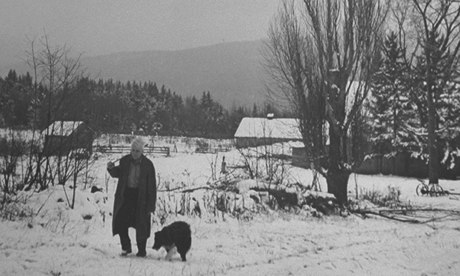
Ezra Pound at the Home of William Carlos Williams, Rutherford, New Jersey, June 30, 1958

Labeled as modern poetry’s most distinguished advocate, Ezra Pound brought modern poetry into the public eye forcing the world to notice it. Pound conjured up a continual pursuit for literary advancement. Several very influential meetings with the supreme intellects of his time lead to Pound’s formation of the Imagist Group in 1912 composed of Hilda Doolittle, Richard Aldington, and F.S. Flint. The group was dedicated to discovering new philosophies of thought and experimenting with new changes in verse form. Objectivity, efficiency and creativity seem to be the three pillars that this group was founded on. The poets who call themselves imagists write with these aspects at the forefront of their art.

The selected poems of Pound’s that are in Ramazani’s anthology all show Imagist devotion. Poems like A Pact and In a Station of the Metro exemplify the imagist movement toward simplicity mixed with an objective perspective. The Rest and The Return challenge traditional meter and voice by using lyrical pattern and repetition. Despite the success of these poems, it is interesting to look at other works of Pound and their lack of inclusion in the anthology.

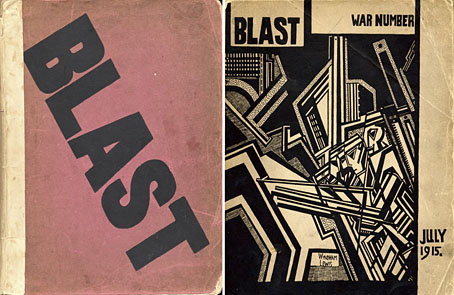
While researching for different works from Pound I discovered from the “Modernist Journals Project” Before Sleep, which was published in the English journal, edited by Wyndham Lewis, called BlastNo. 1 (1914-06-20).

Blast Magazine constructed in 1914


The lateral vibrations caress me,
They leap and caress me,
They work pathetically in my favour,
They seek my financial good.

She of the spear stands present.
The gods of the underworld attend me, O Annubis,
These are they of thy company.
With a pathetic solicitude they attend me;
Undulant,
Their realm is the lateral courses.

Light!
I am up to follow thee, Pallas.
Up and out of their caresses.
You were gone up as a rocket,
Bending your passages from right to left and from left to right
In the flat projection of a spiral.
The gods of drugged sleep attend me,
Wishing me well;
I am up to follow thee, Pallas.

This poem discusses the counter-forces at play on an individual when he or she is awake or asleep. The Reader feels the intense power of light and dark, due to the spelled out descriptions of the actions taking place in the poem. This poem steps away from the bleak open-ended interpretations of Pound’s imagist pieces, and instead relays a clear message that has an intentional emotional agenda for the reader. Pound uses word and phrase repetition in this piece, which is very anti-imagist. He also uses old English style and word choice, suggesting almost a romantic feel.

This shift in writing style arose out of Pound’s work due to his sudden disdain for some of the new forms of Imagist poetry. They began to carry a style of sentimentality that he did not appreciate. Out of this he created a new movement called Vorticism, which suggested a force rather than an image. In this poem in particular the reader can see the prominent dynamistic tone, which came to more minutely define Vorticism. Dynamism can be defined as the quality of being characterized by vigorous activity and progress. There is no need for the reader to infer what is happening in the poem because it is now actually acted out by the speaker.

Posted in Archival | 1 Comment

Changing Ezra: Pound’s Punctuation Choices


Simply Ezra

Simply Ezra

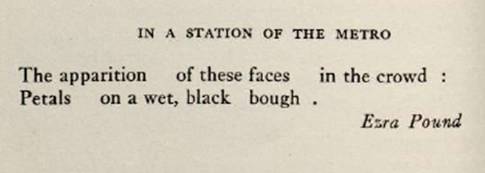
Randolph Chilton and Carol Gilbertson, both college professors whom are considered to be top Ezra Pound researchers, published the article “Pound’s “‘Metro’ Hokku”: The Evolution of an Image” in an attempt to understand the concise poem’s place within the imagist movement.  The article articulates that Pound’s poem, “In a Station of the Metro” was reaching a monumental status within the poet’s collected work as the shining example of imagism.  The authors present readers with original printings and various revisions of the poem in order to help prove Pound’s diligent and deliberate work on this poem.

The most drastic change in the short poem’s form was the end of the first stanza.  Originally, and in many revised copies, the punctuation separating the two ideas was a colon; it was in the fall 1916 issue of Lustra in which the punctuation was switched to a semicolon.  It may have been a misread by an editor, or as the authors suggest, Pound most likely labored intensely over each minute detail of his tidy imagist poem.

Early Version

The change meant the furthered separation of the two images.  The authors claim that Pound’s poem traces “the precise instant when a thing outward and objective transforms itself…inward and subjective” (Chilton 231).  This new structure presented the poem as two clusters of nouns, two images, separated, rather than mixed.  Chilton and Gilbertson describe the semicolon use as the poet guarding his intellectual activity during his experience at the metro.  Pound, with the editing of one simple piece of punctuation styled is poem more like that of a western haiku that followed the imagist criteria.

Final Version

In the work’s earlier stages, Chilton and Gilbertson show how the spacing of the condensed words varied.  The article argues that Pound underwent a stylistic change in which he began to group words together based not on rhythm, but rather based on the relation of ideas.  The authors claim that Pound’s move was to think “more theoretically about the relationship of a visual and emotional reality reflected in the poetic form he discovers” (Chilton 228).  This fundamentally radical understanding of poetry is in accord with Gertrude Stein’s idea that poetry needs to attempt to capture reality similar to the mode of a painter; Pound’s poem, the authors argue, is more the poet finding “language in colour.”  The semicolon was not merely a move for a new form, but the authors claim that Pound’s multiple revisions reveal the “evolution of his genuinely modernist poetic” (Chilton 232).  Pound was a vanguard of imagism and with this work he would display a transition in the application of recognized literary norms.

Here’s the article!

Posted in Critical | 1 Comment

Hinging on a Semi-colon: Pound’s Deliberate Punctuation

In the article “Pound’s ‘Metro’ Hokku: The Evolution of an Image,”  Chilton Randolph and Carol Gilbertson argue for the subtle importance of Pound’s choice of punctuation in “In a Station of the Metro” in the context of Pound’s Imagiste and Vorticist aesthetic. They note the significance specifically of Pound’s use, in the final published version, of the the semi-colon rather than a colon at the end of the first line, arguing that this altered format indicates both Pound’s debt to and distinction from the Japanese haiku and moreover embodies an entire unspoken theory of art, that is, Vorticism. Throughout the article Randolph and Gilbertson cite two of Pound’s  most illuminating essays on the subject of modern verse, “A Few Dos and Don’ts by an Imagiste” and “Vorticism” to form and reinforce their argument. They mention Pound’s declaration that “the one image poem records the precise instant when a thing outward and objective transforms itself, or darts into a thing inward and subjective” to show that the integrity of the poem as an untreated “relation between ideas”  rather than a narrative composition of rhythmic units hinges on the semi-colon, for it “creates a mental leap” by which the reader can physically reenact the darting of the outer image into the inner image in the mind.

They go on to assert that the instability of the semi-colon as opposed to a colon reflects Pound’s theoretical principles and in this way (though his principles are decidedly founded on disjuncture and fragmentation) ground the poem and give its “vorticist dynamic” and its powerful, lasting effectiveness. Thus, most importantly, Gilbertson and Randolph assert, that the formal experimentation embodied with “In a Station of the Metro” traces “not only a struggle with “rhythmic” units or visual appeal, but the difficult evolution of [Pound’s] genuinely modernist poetic.”

Posted in Critical | 1 Comment

Encounter in a Frosted Wood

Frost and Dog: Encountering a Photographer

In an article by Baron Wormser entitled “Robert Frost and the Drama of Encounter,” Wormser points out how “Frost prefers to present the situation, which is to say the drama of opposition or indifference” (Wormser). What he means by this is that Frost finds every encounter to be a genuine one or one deserving of analysis or emotional response. That response is not usually a harmonious one when it comes to Frost. Wormser sets up his analysis of Frost and the encounter with suggesting how much of American poetry before Frost spoke to “the American belief in a destiny,” a destiny “that can face down any conflict”(Wormser). However, he says that Frost isn’t apart of this and that his poetry instead represents a poetry that is “stoutly dramatic and reveals in what can’t be resolved”(Wormser)”

For Wormser, this inability to resolve certain dramatic conflicts led many poets like Frost to instead favor what he calls “the wasteful ardor of encounter, incomprehension, and confrontation“(Wormser). This in itself is a very modern practice of Frost’s poetry.

Wormser makes a comparison that at first sight he himself declares to be seemingly risky. This is the comparison between Robert Frost and Emily Dickinson. He points out their both living in New England and their sharing of poetry that contains encounter, incomprehension, and confrontation. He states how they both possess an inward form of scrutiny that was possessed by the puritans. But he chases this claim with the obvious fact that they both rejected theology. He also says that unlike the extremes of Dickinson’s poetry, Frost’s poetry falls more in the middle and is “bewitching, homely, and extreme”(Wormser).

Wormser abandons his comparison of Frost and Dickinson to focus directly on Frost. He begins to discuss the significance of Frost’s poem “Mending Wall” and particularly how the line “it seems to me” makes clear “the narrators limited powers of discernment” to help reference his idea of encounters and their incomprehensibility in nature. Wormser also says that Frost in this poem, and in many of his others, is trying to convey a primitive and self-satisfying nature that humans possess. He also discusses how encounters such as these were interesting to Frost because they were human and natural. Also, Wormser states that Frost was someone who was a roamer that was also questing and questioning. This is something that is highly evident in his poetry.

Wormser also references Frost’s poem “The Woodpile” and further points out Frosts hunger for encounter and how it is a perfect example of the Frostian mode of poetic setting. This Frostian setting consists of a speaker on a walk in nature that has encounter which allows nature to entertain questions on him. This same process of allowing nature to entertain is also, according to Wormser, present in Frost’s poem “The Most of It.” In this poem, Wormser states that Frost is trying point out the limitations of the human ego. In this way, it can be considered Frost having an encounter with the inherently human part of himself that is the ego.

He concludes his article with a close reading of Frost’s poem “For once, Then, Something” and makes clear how it represents our human quest towards some real form of certainty. This certainty that we cannot really attain. Wormser says that it represents how if we look too much into science and rule out the possibility of greater things then we will be wasting an integral part of our humanity. Wormser ends by describing the encounter found in this poem as “a wisp, a glimmer, a shard” to point out how it represents our sincere human uncertainty that Frost tries to manufacture for the reader of this poem (Wormser).

Baron Wormser. “Robert Frost and the Drama of Encounter.” Sewanee Review 119.1 (2011): 76-90. Project MUSE. Web. 30 Jan. 2014. <http://muse.jhu.edu/>.

Posted in Critical | 1 Comment

Easter 1916: Politics and Poems

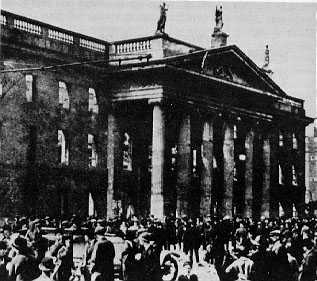
On the twenty year anniversary on the of the Easter Rising of 1916, Pat Devine wrote a piece detailing the events of that now infamous day in the April, 1936 issue of The Labour Monthly.  The article included the declaration from the Irish Republican Army (IRA) for the independence of Ireland. What followed was a week of bloodshed as the small group went to war with English officers in the hopes of gaining freedom for their homeland. Finally on April 29, 1916 the band surrendered, and according to Devine’s article, there were a total of 1,306 casualties (229).  This obviously caused outrage in the minds of those who thought like those members of the IRA, who would lay down their lives against oppressive imperialist forces.

This topic was also one that was very prevalent in the mind of poet and nationalist W.B. Yeats who was constantly calling for those of his country to resist the Anglicising of Ireland. In His poem “Easter, 1916” Yeats talks of that very day. As it was first written in September of 1916 Yeats uses the poem as a political conversation piece to bring to light what had happened that spring. He opens the poem with talk if the modern day, passing on the nameless faces on the street, only to then mirror that with the brave images of the ones who woke up and did something. He was, in a sense, urging those nameless faces to wake up from their grey state and realize what was happening around them.

It makes sense that something of this nature would appear in the pages of Labour Monthly

Easter Uprising 1916

. The magazine seems to be for those who are cut from the same cloth as members of an organization like the IRA. It just goes to show that even twenty years later, the same political thoughts still burned in the minds of western readers.

Posted in Archival | 1 Comment

Meanwhile, in 1912…

Gertrude Stein

Gertrude Stein

Lover of Picasso and other cubist painters, twentieth-century poet, Gertrude Stein, sought to “rediscover what lies behind nouns” (Ramazani 177). This desire heavily resonates in her poetry, including “A carafe, that is a blind glass.“Never before had a carafe, a glass flask typically used for serving wine, been so strangely and precisely described. Stein’s modern twist on what such a simple noun brings to the table, pun intended, was revolutionary. However, revolution and innovation seemed to be the prevailing zeitgeist for 1912.

Meanwhile, in 1912The Futurist Movement was creating an artistic revolution that reached across almost every medium of art, including painting, sculpture, ceramics, graphic design,industrial design,urban design, theatre, film, fashion, textiles,literature, music, architecture. This cultural revolution, also likened to a social movement, emphasized themes such as speed and technology, and embraced modernity in terms of art and culture. The very essence of this movement screams of Gertrude Stein and her work with creating a distinctive “avant-garde” era of poetry. Just as the futurist movement embraced the disjunctive, Stein created phrases and poetry that fit together in unusual and unpredictable ways.

A taste of the futurist movement:

futurist

Giacomo Balla, Abstract Speed + Sound, 1913-1914

Meanwhile, in 1912…Robert Falcon Scott leads the ill-fated Terra Nova Expedition to the South Pole. Scott led a party of five that eventually reached the South Pole on January 17, 1912. Unfortunately, when he arrived he discovered that he had been beaten out by Roald Amundsen who had led an expedition to the South Pole a few months prior. Defeated, Scott and all four of his companions died on the trip home. Despite its unfortunate ending, Scott’s expedition shows much of the exploratory spirit that is characteristic of Stein’s poetry.

1280px-Scottgroup

Scott and his crew

Meanwhile, in 1912…The African National Congress is formed to increase the rights of the black South African population. It was originally called the South African Native National Congress when founded on January 8, 1912 at the Waaihoek Wesleyan Church in Bloemfontein. The Congress was founded in direct response to unjust actions by government officials to black South Africans. It became the ruling party of South Africa on the national level in 1994 and has remained as such to present-day. As Stein was pushing against the norms of traditional poetry, South Africa was simultaneously rebelling against the boundaries of their unjust political structure.

South African protesters against aparteid

South African protesters against apartheid

Meanwhile, in 1912…the Republic of China is proclaimed. The Qing Dynasty comes to an end in China after ruling since 1644. The dynasty fell due to civil unrest and foreign invasions, in favor of the more democratic, although communist, political system called the Republic of China. This same basic political structure is still in place today. While Stein sought reform in the artistic sense, China gave their political structure a complete make-over.

flag of the Republic of China

flag of the Republic of China

Posted in Chronos: Arts & Culture, Chronos: Science, Technology & Ideas, Chronos: Social Change, Chronos: War, Politics, & Nature | Tagged , , , , , , | 1 Comment

H.D.’s “Oread” and the Fragmentary Whole

R.P. Blackmur must have had Hilda Doolittle’s short poem “Oread” in mindwhen he declared her poetic style to be “cold, ‘Greek,’ fast, and enclosed” (ANTH 393). The title creates the addressee of the poem and sets up an apostrophe to the ancient Greek mountain nymph. The nymph becomes the muse whom the poet must invoke in order to capture, in an image, the mountain scene that she describes.

The comparison of the mountain to a sea sets up much of the language as well. The speaker asks Oread to “whirl,” to “splash,” and refers to Oread’s “pools of fir” (2, 3, 6). This is all very water-related language. The speaker refers to himself in the first person plural point of view. It is “our rocks” and he asks Oread to “cover us” (4, 6). I say he just for the sake of efficiency. Who the speaker is, exactly, is unclear. It could be the poet and other witnesses to the scene. It could be one mountain in a chain of mountains wishing to be covered in life. While this seems mostly like critical writing, it helps to know the poem before trying to imitate it.

“Mnemosyne”

Seep in, lake—

Seep into your crevices,

Work your fissures

On our concrete,

Send your blue over us,

Blend us into riverbed.


The basic idea of this imitation is that a Dam is the speaker and Memory is compared to a lake, man-made or natural, that the speaker wishes to see destroyed so that memory can flow freely again. I tried to maintain HD’s repetition of “whirl” in lines one and two and “pines” in lines two and three (not the words themselves but the fact that the are repeated). I also tried to maintain the idea, especially in the last two lines that the speaker is being covered. It also seemed important that most of the lines began with a request so I tried to maintain that as well. I’m not sure that blue is the right color for memory, but it’s an imitation after all.

Posted in Creative | 1 Comment