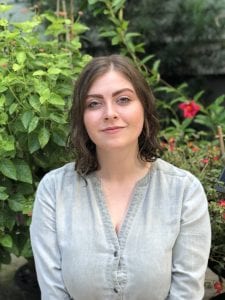
All year, Thomas Coughlin and Ren Jones worked twenty hours a week at the Avery Research Center learning the art of special documents preservation and reckoning with South Carolina history firsthand. Here are their takes on what they did and learned.
Thomas Coughlin
When the Avery Research Center posted positions for graduate assistants for the 2018-2019 Academic Year, I was excited to learn more about its history and collection. Now in my final weeks as a graduate assistant at the Avery Research Center (and candidate in the MFA program), I am so proud to have worked for this august institution here at the College of Charleston.
The range and depth of my work with Avery and the Race and Social Justice Initiative (RSJI) have exceeded my expectations for the kind of work available to a graduate assistant. Avery has afforded me the opportunity to serve its mission: to collect, preserve, and promote the history and culture of African Americans in the Lowcountry. Through hands-on work in the archival collections and with the public events Avery and RSJI sponsor, I have gained special but essential knowledge and experience: I have developed my editorial skills and acquired knowledge of archival best practices, all toward learning the mutual influences of history and activism.
 The history of Avery begins in the months after the Confederate surrender at Appomattox, when former abolitionists from the American Missionary Association founded Avery Normal Institute, a school for Black Charlestonians. The school lasted until 1954, having been turned to a public high school in 1947 and shuttered by the Charleston County school board as part of funding cuts after the Supreme Court’s decision in Brown vs. Board. In 1978, its alumni and other leaders founded the Avery Institute for Afro-American History and Culture, first to secure the old Avery Normal building at 125 Bull Street for the repository that would become the Avery Research Center for African American History and Culture at the College of Charleston.
A daunting honor has descended upon me in my approach to the ongoing archival and outreach projects on which I have been asked to assist. My own very minor contributions to this legacy that spans the post-Civil War history of Charleston, the State of South Carolina, the South, and the United States have been allowed by this very rare opportunity at the College.
 With instruction from my supervisor, Aaisha Haykal, Manager of Archival Services, I have learned how to organize archival collections into formal inventories, and how to write their finding aids: abstracts, biographical / historical notes, collection overviews, suggested subject headings based on Library of Congress Authorities, and descriptions for each item in the collection. The processing of any archival collection requires the creation of a finding aid, “a description of records that gives the repository physical and intellectual control over the materials and that assists users to gain access to and understand the materials.”[1] Archival collections span widely, from one box to dozens. Each holds often many folders, or even folders within sub-boxes. An electronic finding aid enables and eases digital access to a collection.
In a project farther along the line of this process, I helped convert a series of existing paper finding aids for eventual digital access. This project touched the breadth of Avery’s collections, through overlapping expanses of time and subject: the Holloway Family Scrapbook, 1776-1977; the Avery Normal Institute, 1865-1954, and the records of those affiliated: artists, intellectuals, educators, clergy members, business owners, activists, et al.; the Zion-Olivet Presbyterian Church Records Collection, 1854-1991; the McClennan-Banks Memorial Hospital Papers, 1898-1997; the McNeil and Richardson Family Records, which trace a history from Toby Richardson, brought as a slave to South Carolina in 1810, and his wife, Jane McNeil, to their lineage through the 1990’s; the civil rights legal work of Atty. Armand Derfner, who has practiced law in Charleston since 1974.
Another big project introduced me to oral histories and audio collections and required my fellow graduate assistants and I to find details missing from incomplete finding aids, conduct research to verify certain details, and create collection inventories for them with different annotations: brief abstracts for oral history interviews and a list of subjects and special notes for audio collections. The difference in these inventories reflects the difference between the recordings. As the Avery Oral History Workshop 2016: From Planning to Preservation manual states, “Oral history is a sound recording of historical information, obtained through an interview that preserves a person’s life history or eyewitness account of a past experience.” Audio collections preserve contemporary recordings of lectures, speeches, group or panel discussions, musical performances, church sermons, etc.
 Beyond inventory, I have transcribed a good share of oral histories. These oral histories form parts of several collections: interviews with Sweetgrass Basket makers; interviews, as recent as 2006, from Avery Normal Institute graduates, who provide insights into black family life in the first half of the twentieth century; interviews conducted between 1986 and 1997 of South Carolina civil rights activists on their upbringings, efforts in the movement, and the effects of gentrification. Most recently I have transcribed oral histories of Richmond Bowens of Drayton Hall and Joseph Delany of McLeod Plantation, two men who were born either on or near theose plantations where they grew up and they and their ancestors toiled. Bowens took part in the Second Great Migration when he moved to Chicago after World War II, and the New Great Migration when he returned to Charleston in 1978, where he eventually became gatekeeper of Drayton Hall.
This position has also exposed me to the work of digitization and metadata, all the data necessary to enable researchers to find materials online, for photographs and negatives in Avery’s collections. The materials Ms. Haykal assigned the graduate assistants came from the Boags Modern Arts Photography Studio, once at 32 Spring Street, and the Coards Studio, once at 78 Line Street. This work starts with quantifying a collection and qualifying it based on size, pigment, and type, i.e., print or negative. Ms. Haykal further qualified these collections by prioritizing those negatives in deteriorating condition due to age or exposure. With training from Leah Worthington, Digital Projects Librarian at College of Charleston Libraries, we scanned the negatives from these collections into a clear 16-bit gray scale for eventual display on the Lowcountry Digital Library (LCDL). The group of images I was assigned are memorials, for the most part: funeral portraits, gravestones, cemetery landscapes, the contemporary architecture of buildings and whole streetscapes in Charleston, and landscapes just outside Charleston.
As an extension of the archival work to collect, preserve, and promote, I have assisted Avery’s outreach, often through the College of Charleston’s Race and Social Justice Initiative (RSJI). With financial support from Google, The College was able to launch RSJI as a response to numerous acts of racist violence in the Charleston area. Both Avery Research Center and RSJI sponsor events throughout each semester, hosting talks, panel discussions, forums, and lectures from historians, artists, activists and community organizers, et al., in an ongoing effort to join campus and community together to make always known and advance African American history and culture. Toward these ends, I have helped publicize these events and other goings-on at Avery through social media.
My work at Avery has helped me understand the demands the present makes on the past. I am forever grateful to Dr. Patricia Williams Lessane, Ms. Haykal, Georgette Mayo, Daron Lee Calhoun, II, Savannah Frierson, and Ms. Worthington at LCDL for their leadership and lessons. Led by this staff of dedicated archivists, historians, and activists at Avery, I hope to have helped avail and advance resources from the past vital to informing enduring efforts toward justice and equality.
[1] “A Glossary of Archival and Records Terminology.” Society of American Archivists,