
My Parents and I At My Graduation Senior Year
I always knew from a young age I had some form of anxiety. It seemed to start in middle school. My hands would sweat when a teacher would call on me, my neck would get red when someone I didn’t know well spoke to me, even when I got my first job, I was fearful that I would never be able to talk to customers on my own. This feeling has carried over to adulthood– obviously I’ve learned to control my anxiety, but sometimes I can’t help but sense my middle school self creeping up behind me.
I also knew from a young age that my mom– the woman I look up to so much– struggled with similar feelings. I would see myself reflected in the way she reacted to certain things. I never really knew how to approach her with these types of conversations because it was something that simply wasn’t discussed in our house. Every time I told her I felt like I couldn’t breathe or she saw the rashes that would pop up on my neck, she would simply deem it as “dramatic” or “theatrical,” so I took her word for it. I was about 14 at the time, and took my parent’s word as gospel. She would tell me I needed to go to Church and keep practicing my religion in order to ease these feelings. Being raised as a Catholic definitely impacted my own relationship with mental health. I did not fully understand the impact of repressing these feelings of anxiety, and I don’t think my mom did either.
It took until junior year of high school for her to acknowledge her own anxiety. It was when Covid-19 was at its peak, and my whole family had contracted the virus. My mom was worried for the health of our family, as any mother would naturally be. I remember walking into our dining room and seeing her having what I can now recognize as a panic attack. In that moment I saw her, I knew she had accepted the fact that she needed some form of help coping. A part of me was obviously sad to see her in this state. But another side of me was happy to see that she was finally acknowledging her mental health as something of substance, rather than just shrugging it away
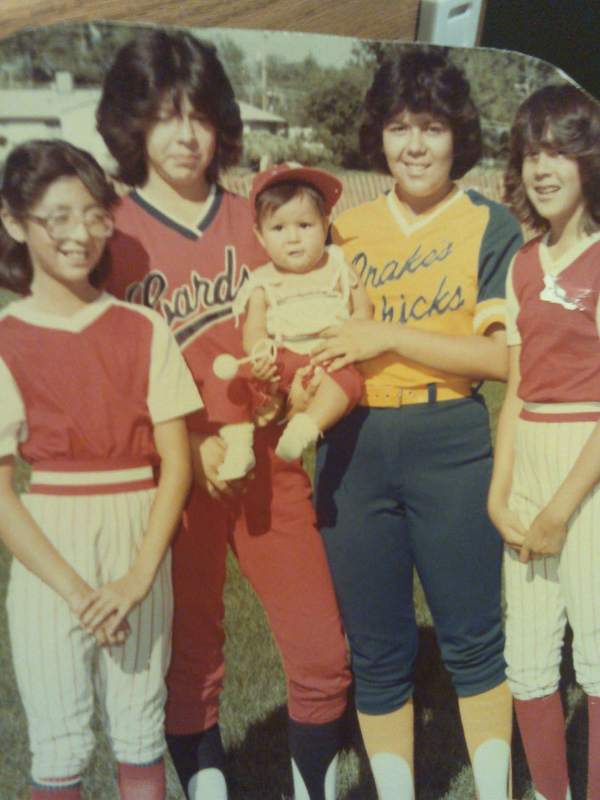
Deborah’s Family Picture
Senior year of high school I finally felt comfortable talking to my mom about my own struggles with anxiety. I was eventually able to find solutions for myself that helped ease uncomfortable feelings. I always felt a strain in our relationship when it came to her not acknowledging my mental health. We have since worked on our relationship and have seemed to grow closer since I moved away for college. She seemed to finally be able to separate mental health and religion, which was a huge step in regards to our relationship. Having a support system in her when I am six hundred miles away from home has been something that provides me with a layer of comfort I never thought was possible.
Deborah Jackson Taffa writes on her own experience dealing with her mother’s mental health throughout the memoir entitled “Whiskey Tender.” Her mother struggles with a depression that seems to play a role throughout the entire text. There often seems to be a lack of communication between mother and daughter that furthers Taffa’s struggles with her identity, trauma, and Indigenous history. One day, Deborah’s mother finds her daughter sleeping in the library. She wrote, “She drove me home in silence. Back then, there was always silence. I couldn’t speak up, I realize now, because protest requires hope.” This quotes seems to show the lack of hope Taffa had when in her mother and her willingness to build a significant relationship with her. I personally felt a connection to this quote because prior to 2020, I always thought that my struggles with anxiety were hopeless in terms of my mother seeing them. Taffa’s mother’s mental health issues seem to stem from intergenerational trauma and the numerous constraints associated with being Indigenous. Although I will truly never been able to understand this struggle, it is interesting to see how mental illness can effect families as a whole, especially when no one seems to address it.
“She drove me home in silence. Back then, there was always silence. I couldn’t speak up, I realize now, because protest requires hope.”
In the text entitled “Reading Autobiography Now,” Watson and Smith discuss “Relationality and Psychodynamic Processes.” This section essentially explores just how much autobiographical subjects are impacted by family and community. These influences often effect the way a narrator may choose to write their story. Whiskey Tender seems to give us an example of this, as we can see how Taffa’s writing is highly impacted by her mother’s emotional absence throughout the memoir.
No comments yet.